
The President's Air Conditioner
In 1881, Navy engineers built an improvised cooling system in the White House to help keep President James A. Garfield alive during a brutal Washington summer.
When most people think about the history of air conditioning, they think of Willis Carrier. But the story goes back much further. In the summer of 1881, a team of U.S. Navy engineers found themselves facing a very unusual HVAC problem:
How do you cool the room of a seriously ill president in the middle of a Washington, D.C. summer—without modern air conditioning?
Their answer was ingenious. And very, very thirsty.
A President, a Sickroom & a Summer Heat Problem
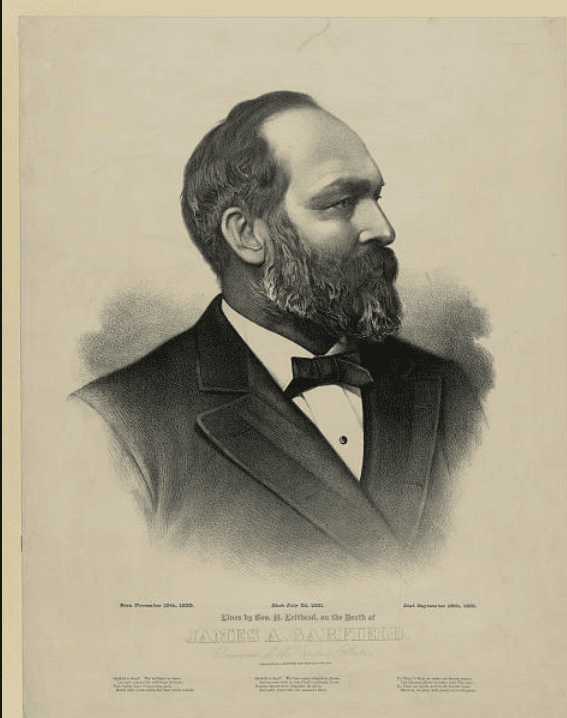
President James A. Garfield was shot on July 2, 1881, only a few months after taking office. Although he initially survived the attack, his condition steadily worsened over the following weeks as doctors struggled to treat his injuries.
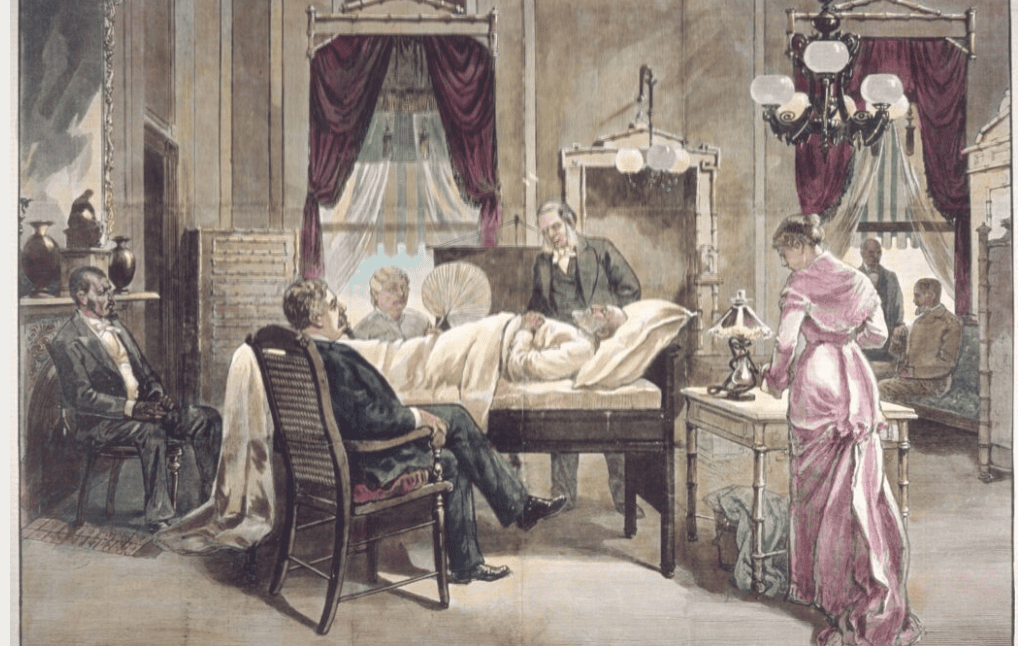
By the middle of a hot Washington, D.C. summer, Garfield was confined to a White House sickroom. The heat and humidity added another challenge to an already serious medical situation, and his doctors and attendants were looking for ways to make the room cooler and more comfortable. There was no modern air conditioner to simply turn on, so the White House turned to U.S. Navy engineers, who were given the unusual task of figuring out how to cool the president's room using the technology available in 1881. What they came up with was an ingenious early experiment in mechanical cooling—and it would require ice, water, an electric blower, and a whole lot of engineering.
Enter The Navy Engineers
With no modern air-conditioning equipment available, the White House turned to U.S. Navy engineers to find a way to cool Garfield's sickroom.
Their solution was surprisingly inventive. An electric blower pushed air through a large chamber fitted with wet cotton screens cooled by ice and ice water. As the air passed through the chilled, damp material, heat was removed before the cooler air was directed into Garfield's room. It was a relatively simple idea, but making it work on the scale needed for the White House required a considerable amount of equipment, ice, water, ductwork, and constant attention.
The result was one of America's earliest serious attempts to mechanically cool an occupied room, more than two decades before Willis Carrier's famous 1902 system.
And yes, it actually worked. The system reportedly lowered the temperature in Garfield's room by roughly 20°F. (whitehousehistory.org)
But Did it Actually Work?
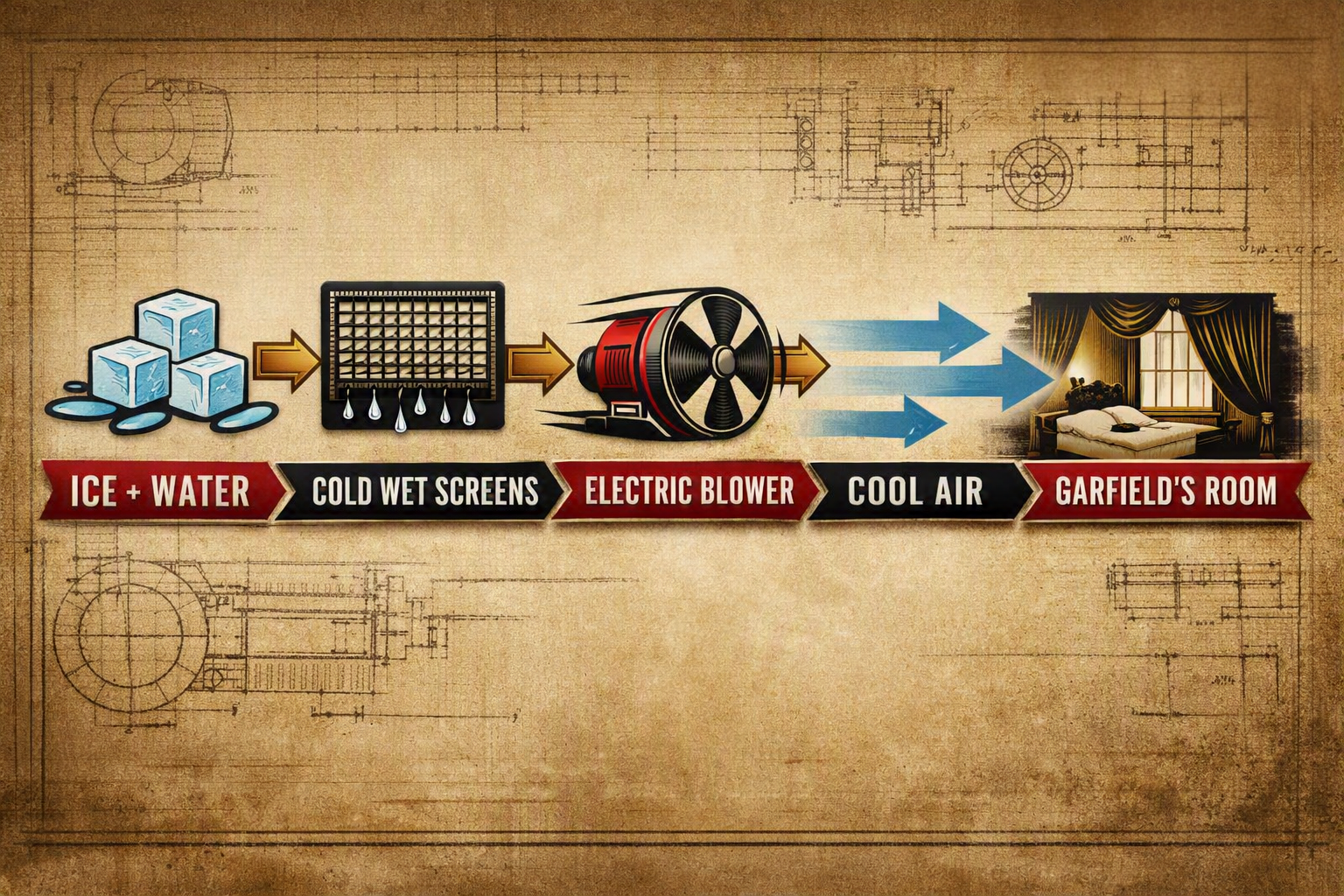
The engineers' improvised cooling system reportedly lowered the temperature inside President Garfield's sickroom by approximately 20°F, bringing the room down to around 80°F even during the hot Washington summer. For a building with no modern air-conditioning system, that was a remarkable achievement.
The system also helped reduce the humidity in the room, making the air more comfortable for Garfield, who was already dealing with serious illness. The goal wasn't to create the perfectly controlled indoor environment we expect today—it was simply to make an unbearable summer room significantly cooler.
And remember what the engineers were working with:
No refrigeration compressor. No modern refrigerant. No thermostat. No central air-conditioning system.
They were using an electric blower, chilled water, ice and wet screens to remove heat from the air. By today's standards, an 80°F room might not sound particularly impressive. But in 1881, achieving a temperature drop of roughly twenty degrees inside a White House sickroom was an extraordinary example of engineering ingenuity. The experiment demonstrated something important:
Air could be mechanically moved, cooled and delivered into an occupied space.
It wasn't modern air conditioning yet—but it was another important step toward the technology that would eventually allow us to control indoor temperature and humidity with the push of a button.
And there was just one rather enormous downside...
It used A LOT of ice.
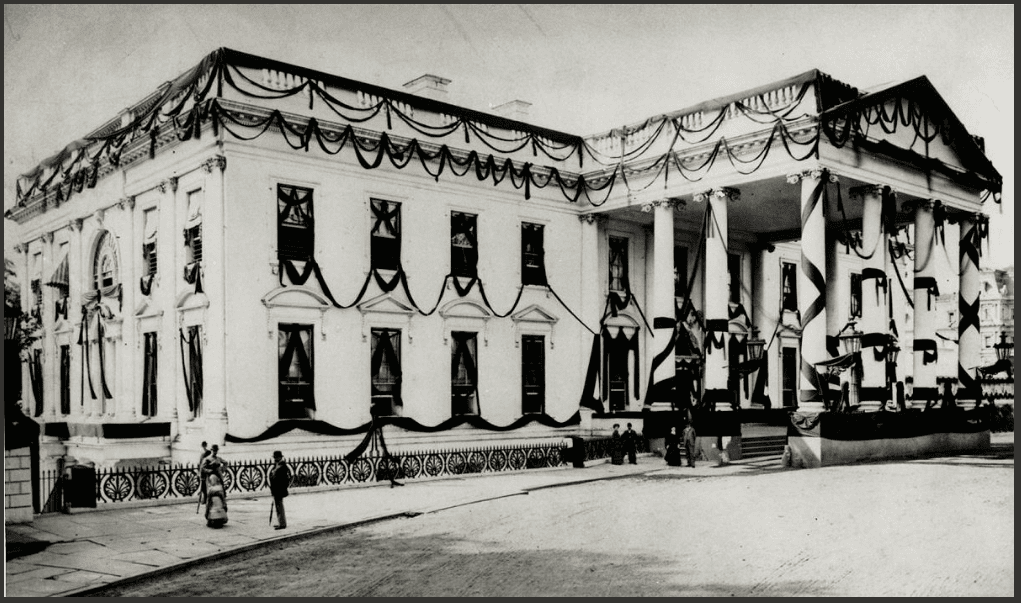
THE PROBLEM? IT ATE ICE.
The cooling system may have worked, but it came with one enormous drawback:
It needed a LOT of ice.
The Navy engineers' apparatus relied on ice and ice water to cool the screens that incoming air passed through. Keeping the system running meant a constant supply of ice had to be delivered and replenished throughout the hot Washington summer.
And this wasn't a few blocks of ice dropped into a machine.
The cooling effort reportedly consumed hundreds of thousands of pounds of ice while Garfield was in the White House sickroom. Smithsonian reports that roughly 500,000 pounds—about 250 tons—of ice were used during the approximately two months the system operated.
Think about the logistics in 1881.
There were no modern refrigerated warehouses producing an endless supply of manufactured ice. Horse-drawn wagons had to bring the ice to the White House, where it could be moved into the cooling apparatus and continually replenished.
In fact, historical illustrations show lines of horse-drawn carriages delivering ice to the White House during Garfield's illness. The White House Historical Association notes that ice was being delivered specifically to help cool the building and aid the ailing president.
The system was clever. It was effective. But efficient? Not exactly.
WAS THIS ACTUALLY AIR CONDITIONING?
That's a surprisingly complicated question. By today's definition, not really. The Garfield system did not use the vapor-compression refrigeration cycle that would later become the foundation of modern air conditioning. There was no refrigerant compressor circulating a working fluid through an evaporator and condenser. Instead, the engineers used ice, water, wet screens and forced airflow to remove heat from the incoming air. That makes the system closer to an early form of evaporative and sensible cooling than the refrigerated air-conditioning systems we know today. But the goal was unmistakably familiar:
Take warm air.
Cool it.
Control the indoor environment.
Deliver the cooler air where people need it.
In that sense, the Garfield experiment was absolutely part of the story of HVAC. It demonstrated that indoor temperature could be deliberately manipulated with mechanical equipment, rather than simply accepting whatever temperature nature provided. And engineers were only getting started.
THIS WAS HVAC BEFORE WE CALLED IT HVAC
One of the fascinating things about early heating and cooling history is that the technology didn't suddenly appear fully formed.
There was no single day when someone invented “HVAC.” Instead, engineers gradually figured out how to solve individual problems:
How do we move air?
How do we remove heat?
How do we control moisture?
How do we distribute conditioned air?
How do we make the system automatic?
The Garfield cooling experiment tackled several of those problems at once. It used mechanical airflow, a cooling medium, ductwork and controlled delivery of air to change the conditions inside an occupied room. Today's equipment is dramatically more advanced, but the engineering mindset is remarkably similar.
COULD THE COOLING SYSTEM SAVE GARFIELD?
Unfortunately, no.
Despite the efforts of his doctors and the engineers working to improve his environment, Garfield's condition continued to deteriorate.
He survived for roughly eleven weeks after being shot before dying on September 19, 1881.
The cooling system could make his surroundings more comfortable, but it could not overcome the serious medical complications he was suffering.
The engineering accomplishment and the medical tragedy became intertwined in one of the strangest episodes in American presidential history.
FROM THE WHITE HOUSE TO MODERN AIR CONDITIONING
The White House experiment was only one step in a much larger technological journey.
Over the following decades, engineers continued experimenting with mechanical refrigeration, ventilation, humidity control and forced-air systems.
In 1902, Willis Carrier developed his famous system for the Sackett & Wilhelms printing plant in Brooklyn, creating a much more sophisticated method of controlling both temperature and humidity.
That system, unlike Garfield's ice-based cooler, used chilled coils and mechanical refrigeration.
The difference between the two systems is enormous.
But look at the timeline:
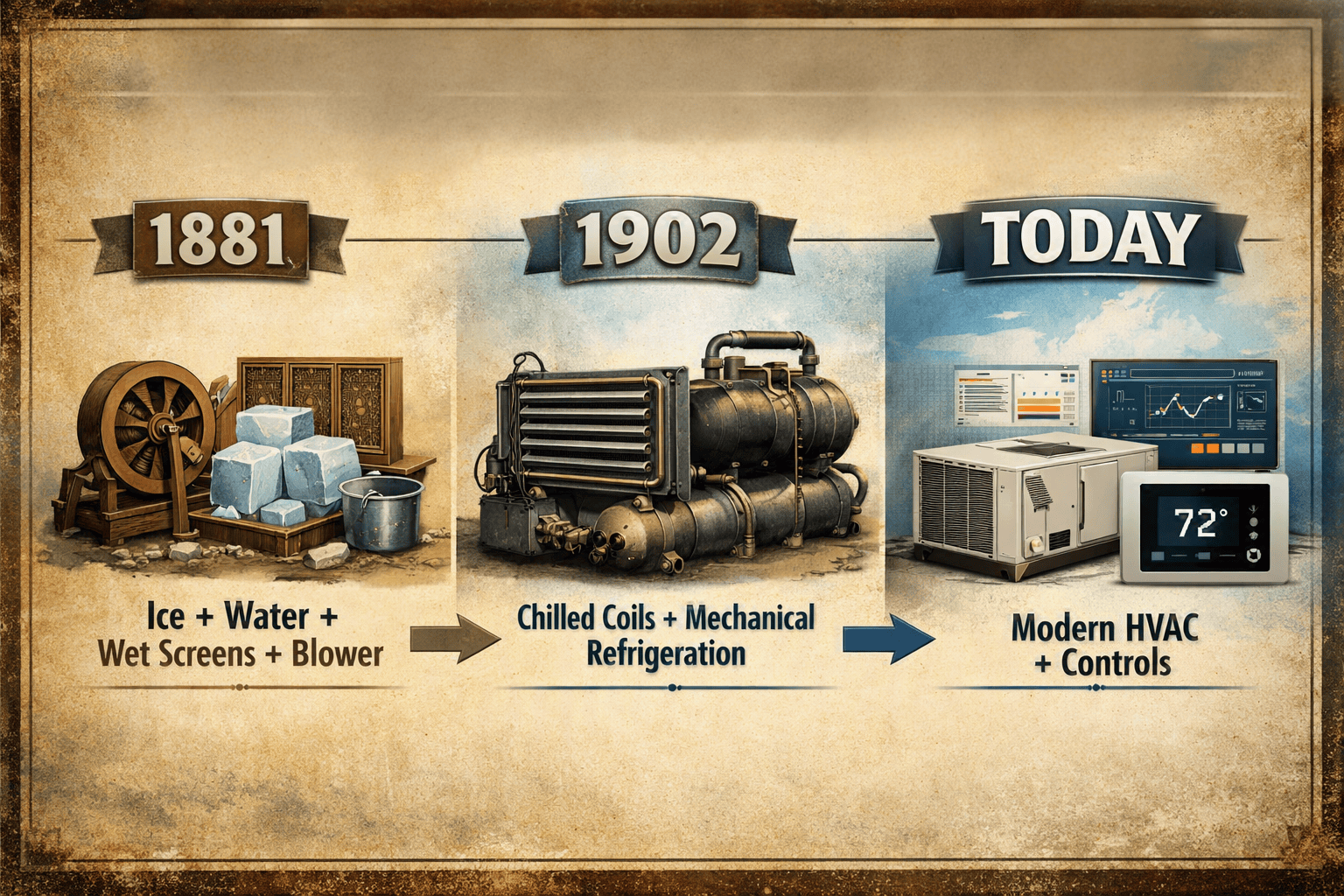

Today's HVAC equipment can make temperature control look easy.
Set the thermostat ---->The system starts ---->The temperature changes ---->Done.
But behind that simple experience is more than a century of experimentation. Engineers have spent generations figuring out better ways to, move heat, move air, control humidity, improve comfort and ultimately automate the process. The cooling system built for President Garfield's sickroom looked nothing like the HVAC systems we work with today. But the problem was familiar.
The room was uncomfortable, and someone needed to figure out how to make it better.
Someone encounters a problem.
Someone asks, “How can we do this better?”
And eventually, that solution becomes the technology we take for granted.
That's what makes HVAC history so fascinating.
Welcome back to This Day in HVAC History.
There's a LOT more history behind that thermostat.